
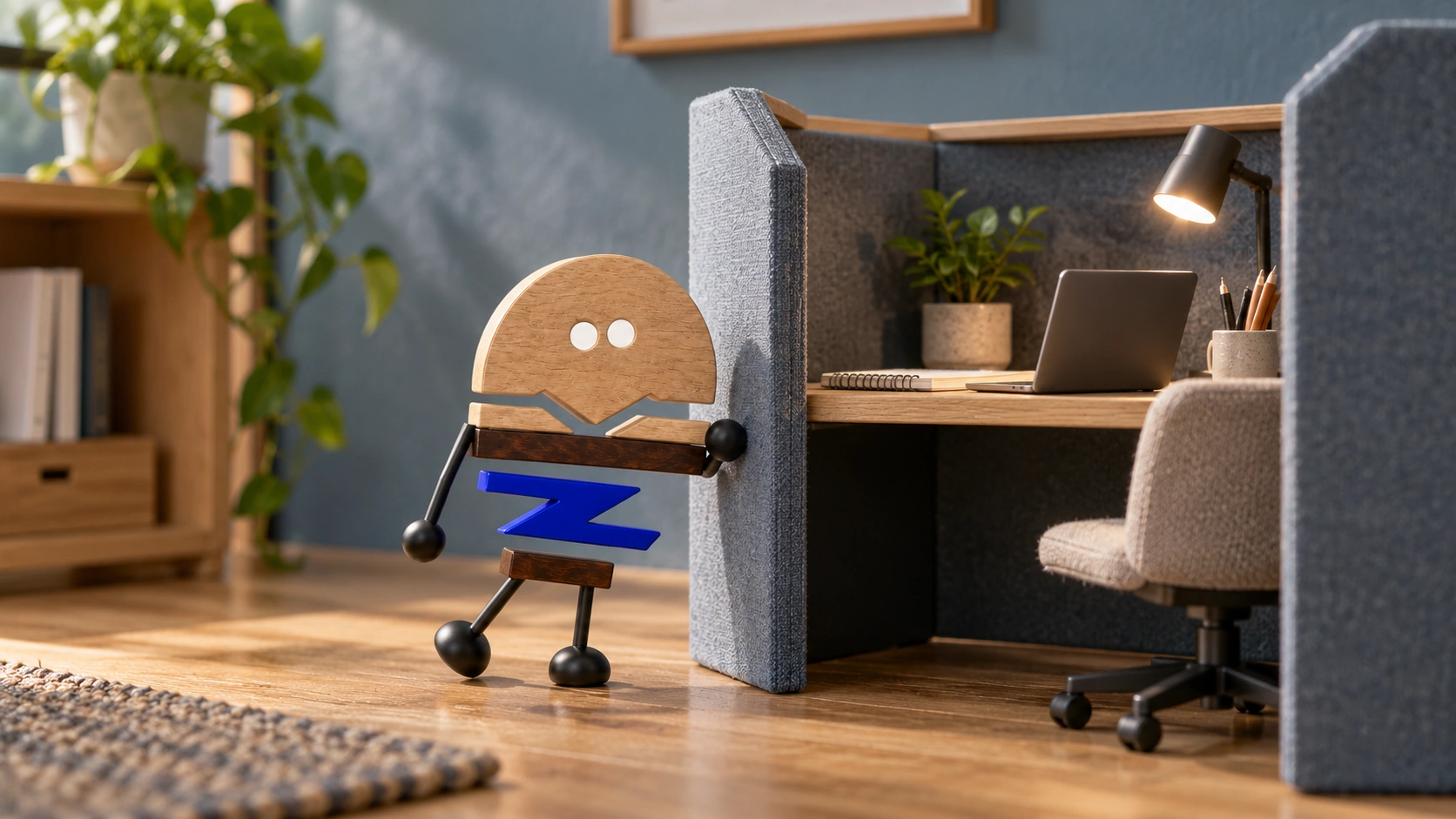
Between an open desk and an enclosed room, a semi-enclosed workstation needs to address sightlines, movement, lighting and service together. More enclosure does not necessarily mean a better fit.
Focus does not have to mean choosing only between an open workstation and a separate room. Some tasks call for a temporary reduction in visual distraction while keeping colleagues easy to reach; others involve sound or confidential information and require different boundaries. The value of semi-enclosure is finding the right middle ground rather than wrapping the desk as fully as possible.
KFI Studios' official Canopy page combines upholstered enclosure, an adjustable desktop, lighting and power in one configuration. This article explores actions inside, communication outside and technical requirements separately, bringing enclosure, use and spatial configuration together.
Meichun observation · 01
Turn distraction into something observable first.
Passing figures, reflections from a neighbour's screen, brief conversations, continuing noise and exposed sensitive information are different problems. A shell that blocks sightlines may not change sound, and reducing visual information does not necessarily make a place suitable for private conversation.
Suppose an employee needs to concentrate on a report while accepting occasional brief questions. The opening's orientation and the conversation position can be discussed. If the activity involves confidential conversation, consider suitable space or a specialist solution rather than continuing to assume an effect from a taller screen.
A clear description of the distraction also makes change easier to assess. If the main issue comes from a passageway, repositioning may matter more than extra enclosure. If the task calls for sound separation, bring acoustic requirements, location and spatial configuration into the same proposal.
Meichun observation · 02
Entry, sitting down and moving the chair determine usability.
An empty semi-enclosed workstation may look generous but feel tight once a chair and equipment are added. Entry, chair clearance, turning and retrieval together determine actual use. Review with the intended furniture and equipment rather than judging from an unoccupied rendering.
Start with the full sequence: enter with work items, sit down, adjust the chair, position the equipment and leave. Record repeated repositioning or avoidance against the particular object and action rather than dismissing it as user unfamiliarity.
The inside of the desk should remain clear as well. Lighting, screens and storage added separately may take up one another's space. A more compact arrangement is not necessarily more focused; suitability needs to return to real work tasks.
Meichun observation · 03
Enclosure changes lighting and equipment relationships.
Natural light, artificial light and video images are affected by enclosure position. Adding a light does not automatically resolve reflections, shadows or maintenance. Observe from the actual seated position with the screen in use, and establish how the light will be serviced and replaced.
Power, interfaces and cables need to be reviewed against the final equipment configuration. If service access is hidden entirely at the rear for appearance, confirm whether it remains reachable after installation and whether other furniture needs to move temporarily.
Upholstery, curved surfaces, a canopy and equipment access can organise the interior together. Record electrical, ventilation and lighting configurations separately to make installation and use clear.
Meichun observation · 04
How do people outside know whether to interrupt?
Semi-enclosure is not viewed only from within. How colleagues find the user, where they stand to talk and how they understand the current state also affect use. If the conversation opening faces the main passageway, a brief discussion may in turn disturb people nearby.
This boundary does not necessarily need a new electronic system. A clear location and simple team arrangements may be enough. If status indicators or sensors are added, consider information handling and management separately rather than treating the presence of technology as a completed operating arrangement.
Teams that collaborate frequently may not need the same strong boundary at every workstation. Allocate semi-enclosed positions, ordinary desks and discussion areas by task, allowing people to choose the appropriate state instead of making one piece of furniture serve every activity.
Compare the states of focused work still in progress and work already finished. Whether colleagues can understand when to approach, and whether the user can return easily to work after a brief discussion, determines whether the middle boundary supports transitions. If repeated verbal reminders are needed, the spatial expression and team arrangements may not yet be coordinated.
Meichun observation · 05
Consider visual privacy, acoustics and confidentiality separately.
Organise visual, sound and confidentiality needs separately: arrange visual boundaries from actual seats and viewing angles, address sound in the site context, and consider confidentiality alongside spatial and management arrangements. Record these three sets of conditions to define focused work, conversation and information use clearly.
When comparing schemes, record product configurations, use and site conditions together. Relationships between enclosure, seating, lighting, power and everyday operation support later selection, installation and use discussions.
Choose the degree of enclosure around the task it needs to support. First describe the distraction to reduce, try the actions inside and communication outside, then review technical and service requirements. That sequence can turn the middle ground into a workstation that remains useful over time.
PRACTICAL CHECKLIST
Bring these questions to the table.
Use these points to discuss product selection, configurations and the requirements of your project.
- 01Types of distraction
Distinguish visual, sound and confidentiality needs rather than grouping everything under focus.
- 02Actions inside
Try entry and exit, chair movement, retrieval and screen operation.
- 03Technology and lighting
Confirm interfaces, reflections, maintenance and the specific electrical responsibilities.
- 04Relationships outside
Keep appropriate positions for finding the user, brief conversation and circulation.
Official brand product information informs the discussion of office furniture and space. Meichun perspectives and manufacturing notes express our views on products and making.
Original illustrations use the Meichun logo character and furniture to introduce product, component and spatial relationships.
- KFI Studios|Canopy Desk|Official product information
The official combination of enclosure, an adjustable desktop, lighting and power provides a reference for semi-enclosed workstations. Internal actions, external communication and configuration planning are Meichun's selection and spatial observations.
View official source ↗ - Meichun|Meichun perspectives on selection and manufacturing · 2026-10-04
Meichun shares perspectives on selection and configuration through use scenarios, product relationships and manufacturing methods. Original illustrations introduce the arrangement of furniture, components and space.