
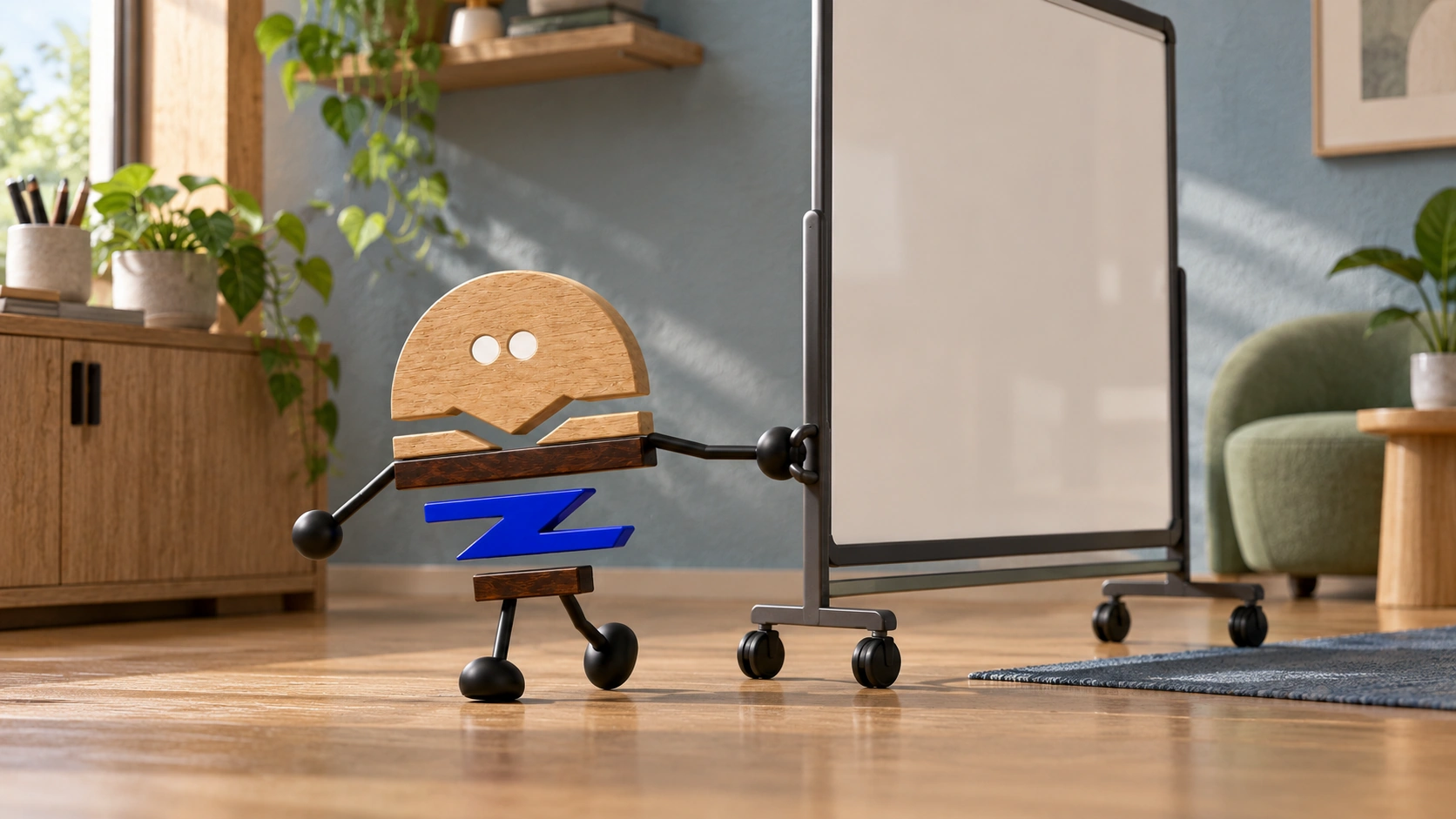
A mobile whiteboard is a writing tool that also affects circulation, sightlines and team discussion. Usability starts with knowing where it should stop.
A mobile whiteboard takes discussion beyond a fixed meeting room, but being able to move describes only half its use. The other half begins when it stops: whether people can see it, whether routes stay clear, who can read the words left on it and where it returns afterwards. As a tool moves between areas, responsibilities for space and content move with it.
LINTEX's official Offset Mobile page introduces writing surfaces, reverse-side use and mobile positioning. This article follows the full route through writing, movement, stopping and returning, arranging locking methods and everyday use according to the instructions for the specific version.
Meichun observation · 01
Use the discussion format to set viewing and writing positions.
A close conversation between two people, a group organising ideas while standing and a long meeting record require different viewing positions. Draw participants' standing or seated locations before setting the board's orientation and writing access. Mobility does not make every position in a room equally appropriate.
Suppose a brief discussion between two people grows into a group presentation. Those at the back may not see clearly, and the writer may block the content. Review the position and activity again rather than simply pushing the board a little further out.
Consider screens, doors and main routes at the same time. A convenient viewing position may obstruct another activity, which belongs in the comparison. Spatial order is not the whiteboard's performance alone, but its relationship with surrounding objects.
Meichun observation · 02
Set a home position before use begins.
Many problems arise after a discussion: the board blocks a cabinet door at the wall, projects into a passageway or occupies the next activity's position. Review its home position alongside doors, storage, cleaning and other mobile furniture.
Walk the full sequence of taking it out, turning, positioning and returning. Observe whether nearby chairs, tables or carts need repeated movement. Pushing it once across empty floor does not establish the whole route.
Plan the route around floor conditions, castors and parking arrangements. Describe pushing, turning and returning clearly so everyday movement and parking each have an arrangement.
The home position and a place for retained content may differ. If a discussion remains on display, provide an appropriate viewing location rather than leaving the tool in a temporary route indefinitely to preserve the writing. Tool, content and space each have their own state; separating them makes the next step clear: move, erase or continue displaying.
Meichun observation · 03
Two-sided use creates actions on both sides.
If one side is for writing and the other for posting or display, both may need access at the same time. Do not place the reverse side against a wall while counting two-sided use as an effective configuration, or assume every mobile board has the same purpose on its reverse.
Selection information should distinguish the writable and display surfaces of the specific version and how each is used. The layout should show which side mainly faces participants, which needs operating access and whether turning or walking around is involved.
After a temporary change of direction, review nearby sightlines and circulation again. Two-sided use is valuable when the relationship works on both sides, not simply because another function appears in a catalogue.
Meichun observation · 04
Moving writing into a public area is a transfer of content.
Discussion may involve customers, projects or internal plans. Once the board leaves its original area, the audience changes. Erasing and returning it should not be treated as incidental chores.
Clarify together who keeps a record of the conclusions, who checks that the board has been erased and what may stay on display. Photographs and saved content should follow the relevant information permissions; ease of movement does not widen the right to circulate it.
Match cleaning to the specific surface. Glass, coatings and other materials should not all be treated as the same erasable board, and routine cleaning needs to be distinguished from repairs to individual areas.
Meichun observation · 05
Test what happens when the discussion ends.
A full trial can include taking the board from its home position, following the actual route, parking, viewing and writing, saving permitted content, erasing and returning. Record where extra people or the movement of other furniture are needed.
If discussion works smoothly but the board is always left in a passageway afterwards, the problem may be its home position and responsibility rather than its mechanism. Conversely, if the route is clear but parking is confusing, return to the product's operating instructions and specific mechanism.
Record product requirements for tipping resistance, locking and floor compatibility alongside movement, stopping and returning steps. Clear correspondence between operation and site conditions supports discussion, cleaning and everyday use.
Meichun observation · 06
Flexible tools should help restore order.
A mobile whiteboard makes room for a discussion, then leaves the space ready for what comes next. A complete plan covers access during discussion, safe parking, what happens to the written content and where the board returns afterwards.
Put the beginning and ending on the same checklist: how the board comes out, how it is used and how space and content return to a suitable state. More flexibility calls for clearer boundaries. This is a product selection question and a spatial operations question together.
PRACTICAL CHECKLIST
Bring these questions to the table.
Use these points to discuss product selection, configurations and the requirements of your project.
- 01Discussion positions
Read from the most distant participant's position and check whether the board blocks screens or circulation.
- 02Parking position
Define its home position and review doors, cabinets, cleaning and turning space.
- 03The specific mechanism
Plan the movement route, parked position and everyday actions together.
- 04Responsibility for content
Set clear rules for recording, erasure and display, so internal information stays out of public areas.
Official brand product information informs the discussion of office furniture and space. Meichun perspectives and manufacturing notes express our views on products and making.
Original illustrations use the Meichun logo character and furniture to introduce product, component and spatial relationships.
- LINTEX|Offset Mobile
The official mobile whiteboard introduction provides a reference for writing, reverse-side use and mobile organisation. Routes, content management and use checks are Meichun's extended observations on space and operation.
View official source ↗ - Meichun|Meichun perspectives on selection and manufacturing · 2026-10-04
Meichun shares perspectives on selection and configuration through use scenarios, product relationships and manufacturing methods. Original illustrations introduce the arrangement of furniture, components and space.