
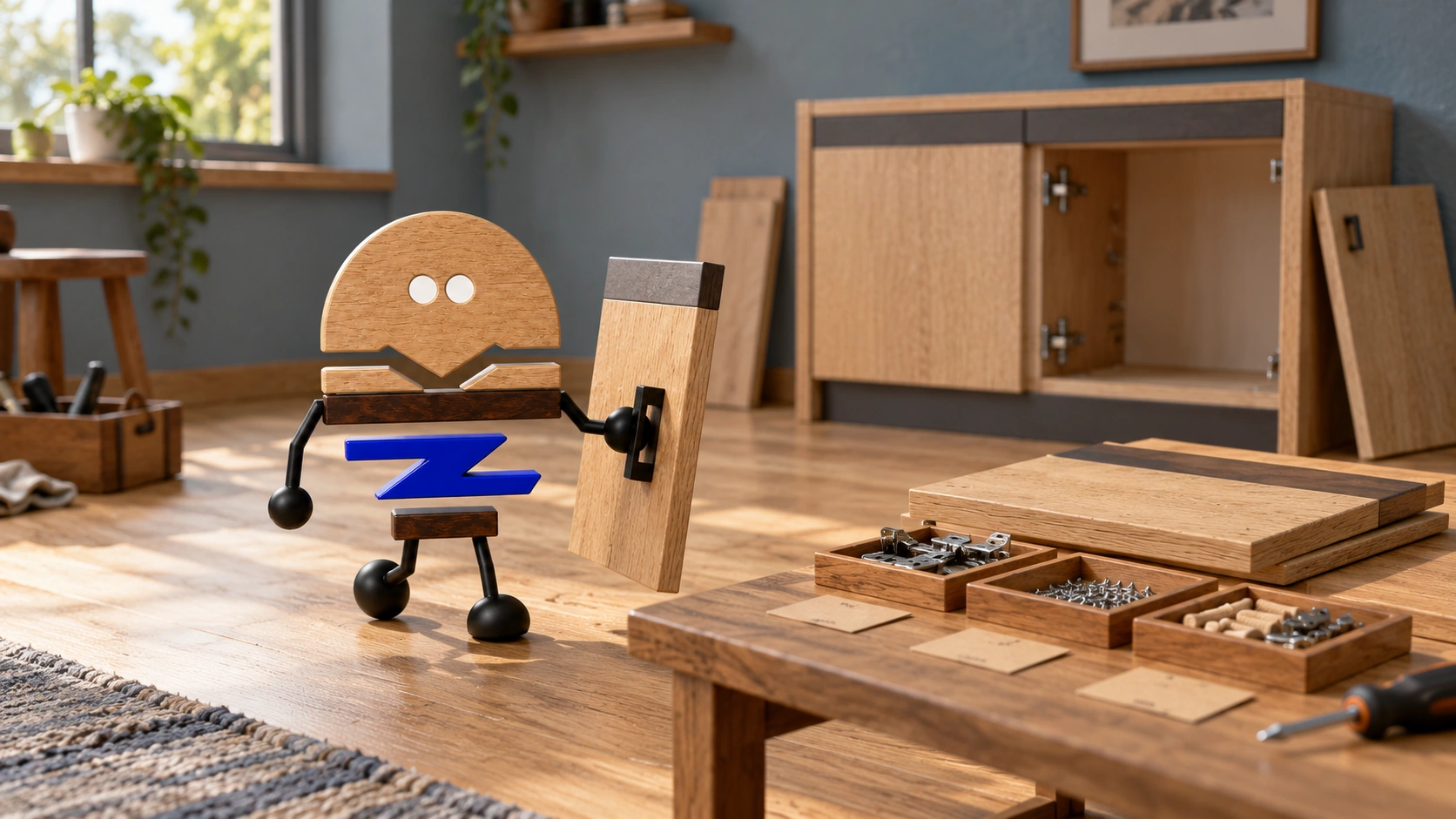
Parts need more than the ability to come apart. Keep their identity, orientation, fittings and version information with them, so the furniture can be put back together correctly.
Furniture is easy to recognise as a complete item, but once dismantled it may become similar-looking panels and a bag of hardware. Discovering unclear left and right parts, mismatched holes or incomplete fittings during reassembly does not necessarily mean the loss occurred in transport. It may have begun when identities and relationships were separated.
Haworth Architectural Solutions' Designing Space That Remembers discusses information continuity from spatial design and delivery through later changes. This article extends that idea to furniture parts, using object, number and connection records to help the next installer identify the correct components and operating documents.
Meichun observation · 01
Before dismantling, record how the whole relates to its parts.
A record saying only this set of desks and cabinets is not enough. The identity of the complete set should connect to panels, fittings and document versions, and similar parts need stable identifiers. Natural grain and old photographs can assist observation, but should not be the only identification method.
Suppose a furniture set moves from its original room to another floor. Before dismantling, record the actual combination and condition so parts, fittings and packaging remain matched. On receipt, this makes it possible to identify which set has missing parts rather than guessing through a pile of similar-looking materials.
Arrange the operating scope, sequence and personnel requirements according to the specific product documents. Record part identities, connection positions and assembly or disassembly steps together so installers can hand over and operate the appropriate version.
Meichun observation · 02
Orientation needs a shared reference.
The left-hand panel is meaningful only when the viewing direction is shared. Identify the user's side, visitor's side, door-opening side or main display face in the records, and use the same reference in photographs, drawings and labels.
If a front view and packaging label use different left-right relationships, more information can make misassembly more likely. Combine an overall drawing with part identifiers and mark fixed orientations and relationships that cannot be mirrored, rather than filling gaps with verbal descriptions.
Orientation may also affect grain, hardware and user movements. A panel that can physically be turned over should not be assumed installable in either direction. The accurate relationship is confirmed by product documents and the responsible party.
Meichun observation · 03
Keep hardware with the connection it serves.
Collecting every screw in one bag is convenient, but may lose specifications, quantities and locations. A list should show where each fitting belongs rather than count only the total. Similar appearance or length does not establish interchangeability.
Follow the specific product instructions to determine which fittings can be reused and which need replacement after dismantling. Mark replacements, reusable parts and their connection positions together so each correct component can be found during reassembly.
If several versions exist, make their applicability clear. A manufacturer retains part lists and relationships to reduce uncertainty in later replacement, not simply to increase the number of documents.
Meichun observation · 04
Leave a handover point at dismantling, receipt and reassembly.
Dismantling records the original condition, receipt checks condition after transport, and reassembly checks the restored result. Review these separately. With one shared intact checkbox, it becomes difficult to locate the stage at which loss or damage occurred.
A handover can stay simple, but must be readable, findable and matched to its objects. Whether a label remains with a part after unpacking, who keeps the list and whether the version was updated all affect the next step.
Before creating a complex digital system, taking one actual furniture set through recording, dismantling, packing, receipt and restoration often reveals weaknesses more clearly. Record part condition, packaging position and handover results at every step to organise the relocation and reassembly process.
At receipt, first check quantities by the identity of the complete item, then inspect each part's condition, and finally determine readiness for assembly from the connection relationships. Do not combine these into matching box counts. Receiving the boxes does not mean the objects inside are complete; having all panels does not mean fittings and versions are correctly matched.
Meichun observation · 05
Keep the records current when the furniture changes.
Relocation may involve replacement parts, configuration changes or modifications. If the original drawing no longer matches the furniture, record the changes and the basis for confirming them rather than simply marking the old list 'done'. The next service team needs to know which version it is working with.
Product tests, reports and installation conditions also have a scope of applicability. When parts change, the responsible party needs to confirm whether earlier conclusions still apply. The same name does not mean an identical state.
Information continuity keeps the objects to check, usable records and maintenance access identifiable after a change. Link each adjustment to the original version so installation, replacement and everyday maintenance remain clearly connected.
Meichun observation · 06
Identification comes before a discussion of restoration.
Part lists, the number of dismantling and assembly cycles, and connection condition form the later service record together. Locate panels and fittings by their identifiers during reassembly so every relocation preserves an accurate furniture version.
Long-term furniture use depends not only on materials, but also on whether the people who follow understand how it is put together. Keeping identity, orientation, connections and versions in one chain allows a relocation to become a clear, accountable reinstallation rather than an improvised reconstruction by an experienced person on site.
PRACTICAL CHECKLIST
Bring these questions to the table.
Use these points to discuss product selection, configurations and the requirements of your project.
- 01Identity and version
Can the complete item, panels, fittings and documents be matched individually?
- 02Orientation reference
Use consistent left-right and front-back references, identifying parts that cannot be mirrored.
- 03Condition at each stage
Check dismantling, receipt and reassembly separately and retain handover records.
- 04Operating scope
Follow product instructions to confirm permission to dismantle, replacement parts and professional responsibilities.
Official brand product information informs the discussion of office furniture and space. Meichun perspectives and manufacturing notes express our views on products and making.
Original illustrations use the Meichun logo character and furniture to introduce product, component and spatial relationships.
- Haworth Architectural Solutions|Designing Space That Remembers · 2026-09-07
A reference for information continuity between spatial design, specification, installation and later change. Furniture part identification and handover methods are Meichun's extended observations on installation, versions and maintenance.
View official source ↗ - Meichun|Meichun perspectives on selection and manufacturing · 2026-10-04
Meichun shares perspectives on selection and configuration through use scenarios, product relationships and manufacturing methods. Original illustrations introduce the arrangement of furniture, components and space.