
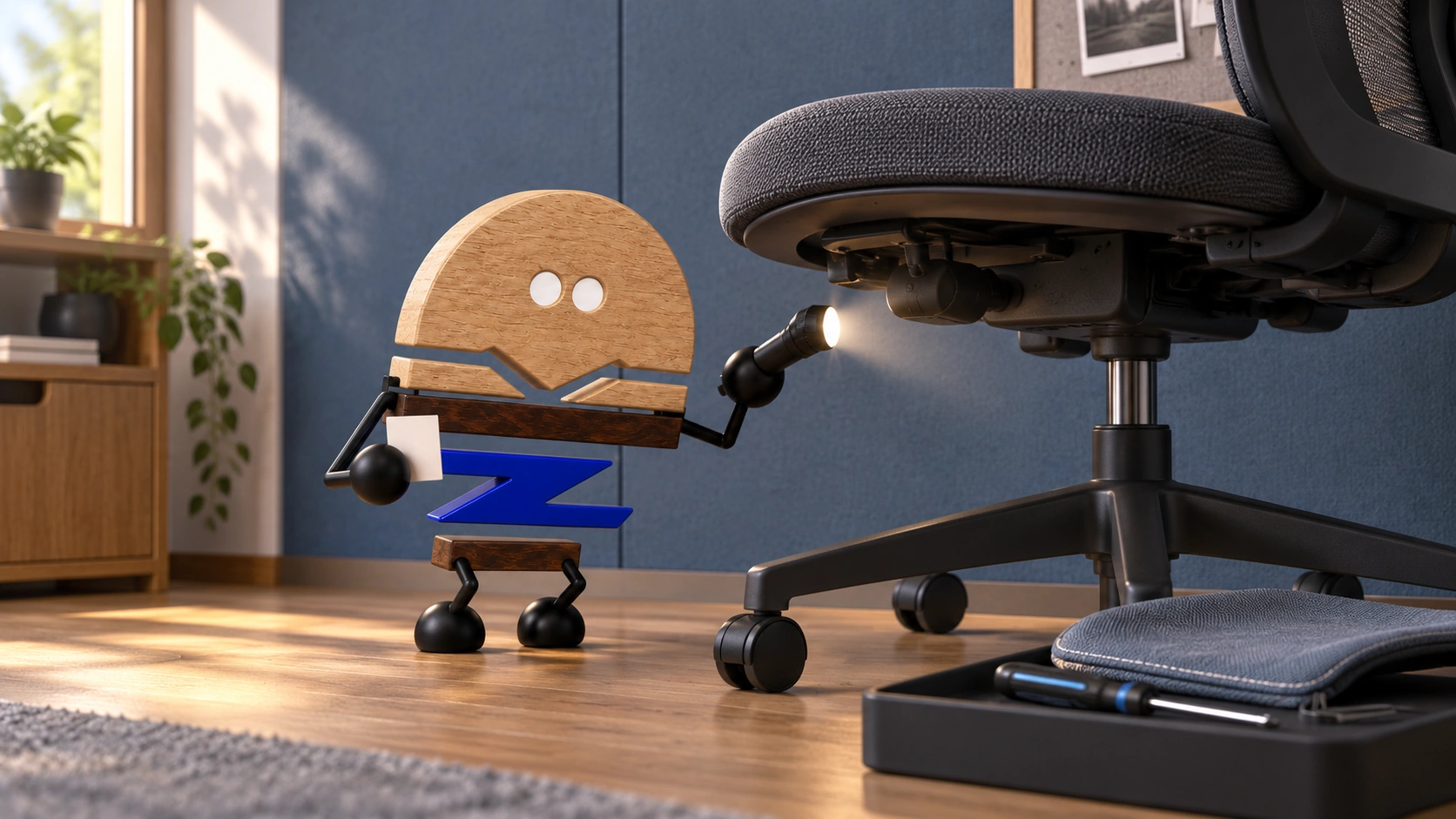
Whether a cover can be replaced is only the first question. A workable maintenance plan also covers who carries out the work, how parts are supplied, the checks after reassembly and the time the chair is out of use.
When a chair cover is soiled or damaged, the manager faces two questions: can the chair remain in use, and what service will return it to use? Replacing the cover is one step in that process. Unidentified parts, unclear operating arrangements or a lack of checks after reassembly can turn a minor repair into prolonged downtime.
AIS describes modular architecture, tool-free maintenance and replaceable components in its public introduction to Reshape. Taking this third-party product as a starting point, this article follows the reporting, replacement and reassembly process to identify practical questions for purchasing and maintenance discussions.
Meichun observations · 01
Identify the problem before opening the chair.
A report that a seat cushion has a problem can refer to surface damage, loose stitching, an issue with the inner material or a support failure. Each calls for a different response. A single front photograph may not tell the service provider whether to prepare cleaning supplies, a replacement cover or an inspection of the whole chair. Describe the affected area, the conditions in which the issue appears and the observable symptoms before deciding on a repair.
For example, staff at a shared workspace may find a loose seam on a chair. They can record the chair identity, damage location and condition, stop or restrict use according to the product instructions, and ask the designated service personnel to assess it. The assessment should guide opening the connection and replacing the cover, together with checks of the inner material and fastening points.
Meichun observations · 02
Provide maintenance access while preventing accidental opening.
Use and maintenance should be clearly distinguishable states. Normal sitting, adjustment and moving should remain separate from disassembly. Maintenance instructions should identify the access point, the fastening to release and the reassembly sequence. Concealed connections can preserve the appearance while still giving maintenance staff a clear route to follow.
Tool-free maintenance reduces the need for tools, but still calls for informed judgement. When comparing proposals, ask designated maintenance staff to remove and reinstall a component using the documents. Check whether the instructions match the actual product, similar parts can be distinguished and the fastening has a clear completed state. Recording steps, part numbers and completion states helps different staff follow the same process.
Meichun observations · 03
Separate downtime into waiting, work and checks.
Time between a service report and a return to use can be spent identifying the model, locating the right spare part, arranging transport, waiting for an operator or completing checks. If an unidentified version is the main bottleneck, faster disassembly will do little to shorten total downtime. Purchasing discussions should cover how spare parts are obtained, their compatibility and the service arrangements, as well as replacement time.
Record these stages separately. Within one batch of chairs, one item may wait longer for a part while another takes longer to repair; combining both into one average hides the causes. The first points to spare parts and identification management, while the second may point to access, documents or fixtures. Knowing where the delay occurs provides a basis for planning spare chairs and service resources.
When comparing service proposals, work through the same surface problem using two defined routes: on-site service and return for repair. Identify what each route needs to establish, wait for and receive. Include transport, temporary replacements and checks to discuss total downtime rather than relying only on the speed of a demonstration.
Meichun observations · 04
Match on-site replacement and professional repair to the situation.
The product and service requirements determine which problems suit on-site work. A cover that can be replaced on site may have a different service route from the inner material, adjustment mechanism or load-bearing components. A clean work area, spare-part storage, the destination of removed parts and the operator's capabilities all affect whether that route works in practice.
Returning a chair for repair involves more than sending it away. Keep the chair, the issue record and any removed components together. Plan transport protection, a temporary replacement and checks when it returns, with clear responsibilities for each step.
Selection can therefore compare two practical routes: how common surface issues are handled, and how an unidentified structural or functional fault is escalated. Each route needs its own operating arrangements. Professional support can be an integral part of a maintainable design.
Meichun observations · 05
Who decides when the chair can return to use?
Removal and reassembly should be reviewed together. Check edge fit, fastening points, stitching alignment and restored adjustment functions according to the product instructions. The maintenance record can also retain the number of removal and reassembly operations, the condition of connectors and the reassembly result for future service.
Replacement parts need a version match. Similar-looking covers may suit different batches, and left and right parts, fasteners and inner assemblies may vary. The maintenance record should tell the next service person what was replaced, which version was used and which checks were completed, rather than simply stating that the issue was resolved.
The value of maintenance lies in a successful return to use. Assess cost, environmental impact and extended service life using records of actual spare parts, transport, disposal and reuse. Clear questions and handover records connect the product's service instructions, repair arrangements and return-to-use checks.
PRACTICAL CHECKLIST
Bring these questions to the table.
Use these points to discuss product selection, configurations and the requirements of your project.
- 01Operating access
Do the instructions distinguish adjustment, disassembly and reassembly, and prevent accidental disassembly in daily use?
- 02Spare-part identification
Do covers and fasteners have precise part numbers, versions and compatibility ranges?
- 03Responsibilities
Who handles on-site, dealer or factory service, and which operations require professional support?
- 04Return to use
Who checks the fastening, functions and appearance, and is the result recorded?
Official brand product information informs the discussion of office furniture and space. Meichun perspectives and manufacturing notes express our views on products and making.
Original illustrations use the Meichun logo character and furniture to introduce product, component and spatial relationships.
- AIS|Reshape award and product introduction · 2026-06-12
The official brand article describes modular architecture, tool-free maintenance, replaceable components and the launch plan.
View official source ↗ - Meichun|Meichun observations on selection and manufacturing · 2026-10-04
Meichun shares perspectives on selection and configuration through use scenarios, product relationships and manufacturing methods. Original illustrations introduce the arrangement of furniture, components and space.